Showing posts with label Books. Show all posts

Tuesday, 28 December 2021

A travel diary with StoryJumper


My youngest secondary students find it extremely difficult to write more than two sentences in English, so you can imagine how they reacted when I told them they were going to write a travel diary… Besides, most of them have never been abroad and don’t know much about other cities and countries. Therefore, I decided that creating a StoryJumper booklet about an imaginary trip to a different country would get them out their comfort zone.

They worked in groups of four; I tried to organize them in a balanced way, so each team has students with different proficiency levels. This can motivate students who really struggle with writing, although there are always some of them who prefer to hide and leave the others work…

The objectives of this activity were:

  • Write an imaginary travel diary using StoryJumper.
  • Use past tenses.
  • Discover and learn about a different country.
  • Work in teams and distributing tasks.

Obviously, StoryJumper is a great tool to encourage learners to write, due to its user-friendly interface and attractive, highly visual final products. Students feel they are actually creating something interesting and beautiful, so most of them are very careful and interested in presenting a good piece of writing with nice pictures.

This is how I planned the task:

  • First, I created and shared an empty booklet with each group. All members could edit it, while I was there as a “ghost” user to revise their work and correct their mistakes at the end.
  • I created a model in order to show them some ideas and shared it with them. Of course, they had previously studied the past simple tense in class.
  • Later, we had a couple of sessions in the classroom with laptops to research, write and create the booklets. They needed extra time at home, since it took more time than I expected...
  • Finally, each group presented their booklets on screen to the rest of the class. After presentations, each student was given a rubric to evaluate the work of the other members of the team.

I must say that not all groups were able to complete the task successfully. Some of them had problems with the app and decided to create a slideshow using different programs. I think that this could have been avoided if the task had been conducted in class exclusively, so I could have helped them solve technical issues. Besides, some of them used Google Translate at home to complete the task… Again, I avoid assigning writing tasks for home because I want to make sure students write their own texts. However, the task was more time-consuming than I expected, so for the next time, I’ll definitely simplify it, or redefine it as a long-term project.   

But there were many positive aspects too. Some of the presentations were nice (like these ones about Peru and Lanzarote) and even the students were surprised about the quality of their work (they are only 12 years old!) Besides, all groups had the chance to learn something about different countries and places, which is great.

To sum up, this is just a trial which makes me want to continue exploring the possibilities of StoryJumper. For future sessions, I will take into account the following:

  • The length of the task (and the model text, if any) should be adapted to the group.
  • It’s better to work in pairs or individually, since it is not easy to manage the whole booklet by large groups.
  • It would be nice to share the booklets in the school’s website to make the results visible.
  • Although I recorded my voice for the model, I did not ask my students to do so, but that would have been a good way to practice some reading and pronunciation.


Thursday, 18 November 2021

Reading habits


Since I was a child, I have always been a total bookworm. My grandfather taught me to read when I was three years old and he really succeeded in instilling in me the pleasure of doing it. While it is true that my reading habits have progressively changed, I still love discovering new worlds and lives throughout the pages of a good book.

https://upload.wikimedia.org/wikipedia/commons/e/ed/Red_House_School_English_class.jpg

Children do not usually choose what they read, unless they feel highly motivated to do so. Instead, they generally read the texts their parents or teachers pick for them. This is quite tricky because, although they may seem interested in what they are reading, sometimes they may feel forced to do it, and that could be counterproductive when it comes to educate engaged readers. However, it is also true that children tend to imitate what they see at home or at school, so it is important to transmit them that reading can be fun and exciting, as well as a daily activity they should integrate in their routine.


http://commons.wikimedia.org/wiki/File:2005_Baimasi_China_58727908.jpg#mediaviewer/File:2005_Baimasi_China_58727908.jpg


As adults, this “forced reading” comes to an end, so we either decide to keep reading for pleasure or simply dismiss it as an ordinary life skill. Those who read because they actually enjoy it are, in my opinion, more open-minded and able to think critically than their non-reader counterparts are. A good reader can plunge into a book for hours and feel like s/he has been under the skin of different people for months or years. It is such an immersive experience that one can remain seated without moving even within the busiest of environments.


https://commons.wikimedia.org/wiki/File:2011_handheld_device_5817790915.jpg#mediaviewer/File:2011_handheld_device_5817790915.jpg

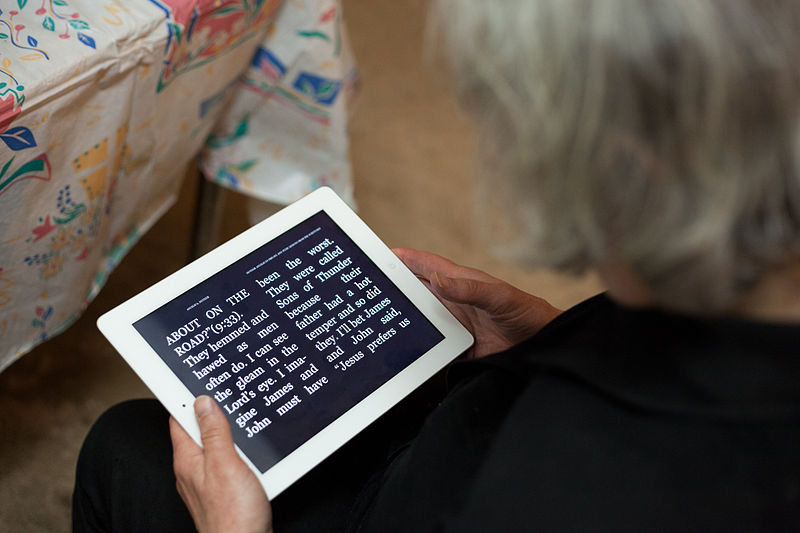
With the recent technological revolution, reading habits change. Not only do we have access to a much wider range of books and texts to be read than before, but also the formats have become incredibly diverse. While some of us still prefer the good old print books and their unmistakable smell and presence, there is no doubt that modern e-books offer a number of advantages, such as mobility or the possibility to save many books in one single device. Needless to say that people with vision problems, such as the elderly, can greatly benefit from this format and continue enjoying an activity that could otherwise be problematic for them.  


https://commons.wikimedia.org/wiki/File%3ABundesarchiv_Bild_183-20728-0003%2C_LPG_G%C3%BCsen%2C_Vorsitzende_der_LPG_mit_Kind.jpg

If I had to describe my experience as a Spanish reader, I would use this picture. As I said before, the role of my family was essential because there were many books at home and they spent a lot of time reading, especially my grandfather. 


https://commons.wikimedia.org/wiki/File%3A2008_BostonPublicLibrary_2223721594.jpg

Regarding English, I started reading seriously when I was at university and my research activity began: only during this period did I use electronic devices to read. Until then, I had used Spanish texts for pleasure (literature: novels, poems, plays…) and English for research (essays, dissertations…) However, this line has become blurrier during the past ten years and now I read texts of any kind in both languages. I often say that enjoy reading whenever I have the time and the space, but it is true that the busy pace of daily life render them virtually non-existent. Therefore, I force myself to find these times and spaces as a gift, at home, after a hard day of work. For a couple of hours, I can be someone different and I can live a different life. And, of course, always beneath paper sheets.