Showing posts with label Reading. Show all posts

Monday, 29 November 2021

A Time Line with TimeToast

 Last week, my students used TimeToast to create a timeline about a British or American band or artist. The main objective of this activity is to read, understand and summarize a brief text by selecting the most relevant information. At the same time, we had the chance to review the past simple –especially irregular verbs!

Creating a timeline with this tool makes them focus on the essential facts of the text and therefore work on their mediation skills. At the same time, they are creating a new, visual product with images and data, which is always rewarding.

First, I chose and adapted some texts and biographies of famous UK and USA bands and artists. In order to facilitate understanding, most of these texts were taken from Wikipedia in simple English, as language is clearer and easier to understand. I added a picture and removed some of the verbs in past simple, placing gaps and brackets instead.

Then, I let students work individually: they had to read the texts and fill in the gaps with the correct form of the verb. After that, they had to find another student with the same text (I managed to form heterogeneous pairs) and read it together.

Finally, I guided them through TimeToast (it took a while for them to sign up, since their digital skills are not extraordinary…) and I told them to create the timeline with the most important facts about the band or artist they had just read about. Years and dates were used as markers to help them.   

During the activity, students were really focused on the task and collaborated all the time. They really liked the option of including pictures and they felt quite happy to see how their work was transformed into a visual product. Although they haven’t finished yet (work in progress!), the results were quite good:

David Bowie

The Beatles

 Spice Girls

I would definitely love to repeat this task with other groups and levels. Still, I think I need to explain more carefully how to summarize information and transform long sentences into short ones, since some of the students weren’t able to do it correctly (they would just write single words from the text, without a proper sentence structure).

So, TimeToast has proven to be a great and fun tool in order to:

-          Make students enjoy reading and working on a text.

-          Teach them to select and summarize the most important ideas in a text by placing them chronologically.

-          Revise grammar and learn new vocabulary about music and art.

Thursday, 18 November 2021

Reading habits


Since I was a child, I have always been a total bookworm. My grandfather taught me to read when I was three years old and he really succeeded in instilling in me the pleasure of doing it. While it is true that my reading habits have progressively changed, I still love discovering new worlds and lives throughout the pages of a good book.

https://upload.wikimedia.org/wikipedia/commons/e/ed/Red_House_School_English_class.jpg

Children do not usually choose what they read, unless they feel highly motivated to do so. Instead, they generally read the texts their parents or teachers pick for them. This is quite tricky because, although they may seem interested in what they are reading, sometimes they may feel forced to do it, and that could be counterproductive when it comes to educate engaged readers. However, it is also true that children tend to imitate what they see at home or at school, so it is important to transmit them that reading can be fun and exciting, as well as a daily activity they should integrate in their routine.


http://commons.wikimedia.org/wiki/File:2005_Baimasi_China_58727908.jpg#mediaviewer/File:2005_Baimasi_China_58727908.jpg


As adults, this “forced reading” comes to an end, so we either decide to keep reading for pleasure or simply dismiss it as an ordinary life skill. Those who read because they actually enjoy it are, in my opinion, more open-minded and able to think critically than their non-reader counterparts are. A good reader can plunge into a book for hours and feel like s/he has been under the skin of different people for months or years. It is such an immersive experience that one can remain seated without moving even within the busiest of environments.


https://commons.wikimedia.org/wiki/File:2011_handheld_device_5817790915.jpg#mediaviewer/File:2011_handheld_device_5817790915.jpg

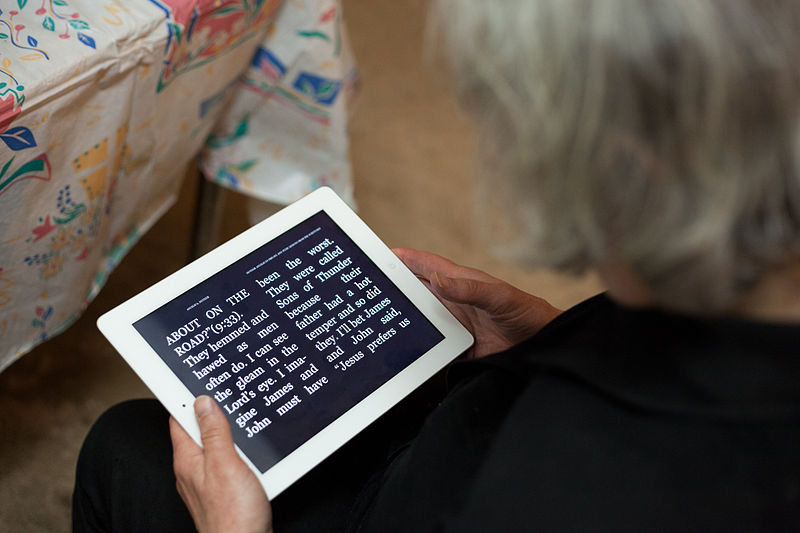
With the recent technological revolution, reading habits change. Not only do we have access to a much wider range of books and texts to be read than before, but also the formats have become incredibly diverse. While some of us still prefer the good old print books and their unmistakable smell and presence, there is no doubt that modern e-books offer a number of advantages, such as mobility or the possibility to save many books in one single device. Needless to say that people with vision problems, such as the elderly, can greatly benefit from this format and continue enjoying an activity that could otherwise be problematic for them.  


https://commons.wikimedia.org/wiki/File%3ABundesarchiv_Bild_183-20728-0003%2C_LPG_G%C3%BCsen%2C_Vorsitzende_der_LPG_mit_Kind.jpg

If I had to describe my experience as a Spanish reader, I would use this picture. As I said before, the role of my family was essential because there were many books at home and they spent a lot of time reading, especially my grandfather. 


https://commons.wikimedia.org/wiki/File%3A2008_BostonPublicLibrary_2223721594.jpg

Regarding English, I started reading seriously when I was at university and my research activity began: only during this period did I use electronic devices to read. Until then, I had used Spanish texts for pleasure (literature: novels, poems, plays…) and English for research (essays, dissertations…) However, this line has become blurrier during the past ten years and now I read texts of any kind in both languages. I often say that enjoy reading whenever I have the time and the space, but it is true that the busy pace of daily life render them virtually non-existent. Therefore, I force myself to find these times and spaces as a gift, at home, after a hard day of work. For a couple of hours, I can be someone different and I can live a different life. And, of course, always beneath paper sheets.